Upload Your News, Articles, Presentations, and More Here
Attention Authors, Presenters, and Influencers
IHRIMedia, the communication arm of IHRIM, publishes articles, journals, and newsletters, delivers webinars, courses, and podcasts, and informs our members and external audiences through exchanges like our websites, social and professional platforms, Technology Review Council and Consortium DeHR.
IHRIMedia also manages requests and uses of IHRIM trademarks, service marks, and copyrights and coordinates licensing and republication requests of IHRIM assets.
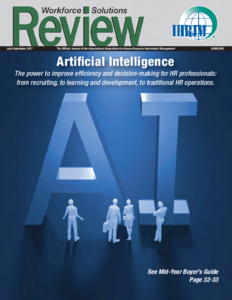
Our flagship publication, Workforce Solutions Review (WSR), is the oldest and only peered-reviewed journal dedicated to HR Technology and HR Information Management. WSR is the official journal of IHRIM, free for members and available for sale and subscription to non-members.
Online seminars, short courses, and research & development sessions from IHRIM's Technology Review Council (TRC) fall under IHRIMedia. Many of these programs, produced by IHRIM's Education Team and Partners, can be accessed on our Learning Management System (LMS) for a modest fee, while select presentations are available on IHRIM's YouTube and Vimeo channels for free.
WHY CREATE CONTENT?
In the past decade, the publishing world changed, and imparting knowledge is crucial to personal and professional growth. Corresponding value propositions have evolved alongside. IHRIM members, colleagues, and friends comprise our readers and our creators; therefore, a fundamental value of IHRIMedia is its well-blended network of human resource and technology professionals with subject matter experts and pioneering thought leaders.
Worldwide, practitioners, consultants, and developers in the HR Tech arena share their practical experiences and applied research daily. Whether one is naturally committed to lifelong learning or must maintain their expertise for credentialing, the thirst for knowledge and solutions drives IHRIMedia to actively and objectively inform the whole IHRIM community.
The payoff for content creators (authors, speakers, editors, educators, etc.) is huge by:
(1) creating greater personal and corporate brand awareness in conjunction with IHRIM;
(2) stimulating direct engagement and striking up ongoing relationships with industry thought leaders and subject matter experts who are willing to listen intently and to criticize constructively; and
(3) reaching a definable community of thousands of influencers in the HR Tech space.
DISCLAIMERS
First, submitting ideas, articles, or complete course slides does not guarantee acceptance. All work submitted to IHRIM for use by WSR, TRC, or our Learning Management System becomes the temporary, copyrighted property of IHRIM until publication or use, at which time the copyright shall permanently transfer to IHRIM along with the permission of the creator to use their name, image, and likeness as IHRIM solely deems necessary.
As noted during publication or presentation, content promoting a product, service, vendor, or company may be classified and identified as sponsored content or advertising. Our Partners should respect IHRIM's objectivity and accept to abide by our Code of Ethics, thus ensuring the decades-long integrity and legacy of IHRIM as product-agnostic and vendor-neutral.
HOW DOES ONE SUBMIT CONTENT?
Fill out the form below.
Articles and ideas for IHRIMedia, including but not limited to, WSR, TRC, or our LMS, are managed by separate editorial and operational committees of experts. They set the topical production calendar each year based on their expertise, market trends, applied research, and news, and they perform an evaluation and editorial process called peer review.
Perr reviewers ensure that articles and presentations uniquely cover human resources and technology disciplines while meeting IHRIM delivery standards. Topics like human resource management without a technology component do not qualify for inclusion and may be better suited to publications by SHRM®, HR Executive®, or other HR-oriented publications and conferences. IHRIMedia does not publish opinions and prefers that content creators focus on technological advances and their applications with their impact on the workforce and employers.
While WSR covers people, processes, products, and practices, TRC offers a forum of new media, e.g., podcasts, vlogs, etc., emphasizing emerging technologies alongside best practices involving HR and related technologies. IHRIMedia welcomes articles and presentations by early adopters among practitioners, academic and applied researchers, start-ups, and vendors of core and non-core HR-related solutions to mid-market and enterprise customers.
MORE ENGAGING OPPORTUNITIES WITH IHRIM
Regularly, IHRIM will host or cohost conferences, mini-conferences, colloquia, and meetings for Special Interest Groups called Huddles. All are welcome to respond to solicitations for presentations and articles under the terms and conditions outlined above. All other subject matter of an educational, non-training nature should contact IHRIM's Chief Learning Officer directly at [email protected].
Thank you for supporting and contributing to IHRIM and broader HR-Tech communities!
"Outstanding topic and speaker."